
If you’ve ever opened a forex tutorial and immediately felt like you’d walked into the middle of a conversation—“risk 1% per trade,” “target 20 pips,” “use 1:30 leverage,” “trade 0.5 lots”—you’re not alone. Most beginners don’t fail because they can’t learn strategy; they struggle because they don’t yet speak the language.
When I first started learning forex, I remember pausing a video every 30 seconds just to translate the jargon into plain English. Once I understood the units of measurement (pips, lots, leverage, margin), the same strategies suddenly became readable—like upgrading from guessing to actually understanding.
This post is that translation layer. By the end, you’ll be able to follow almost any forex strategy or tutorial without getting tripped up by basic terminology—and you’ll understand what the numbers mean for your account.
The big idea: forex has three “measurement systems”
Nearly every trading method, risk rule, or backtest is built on these three units:
- Pips = how far price moved
- Lots = how big your position is
- Leverage = how much market exposure you can control with your deposit (margin)
If you master those, you can decode almost everything else.
1) What is a pip? (The unit of price movement)
A pip is the standard unit used to measure a change in the exchange rate of a currency pair.
In most major pairs, a pip is:
- 0.0001 for pairs priced to four decimals (EUR/USD, GBP/USD, AUD/USD)
- 0.01 for pairs involving JPY priced to two decimals (USD/JPY, EUR/JPY)
Examples (non-JPY pair)
If EUR/USD moves from 1.1000 → 1.1005, that’s 5 pips.
Examples (JPY pair)
If USD/JPY moves from 145.20 → 145.45, that’s 25 pips.
Pipettes (the extra decimal)
Many brokers quote an extra digit (a fractional pip), often called a pipette:
- EUR/USD might show 1.10005 (that last “5” is a pipette)
- 10 pipettes = 1 pip
This matters because spreads are often shown in fractional pips.
2) Pip value: how much money is 1 pip?
Knowing what a pip is helps you read charts. Knowing pip value helps you control risk.
Pip value depends on:
- the pair you’re trading
- your lot size (position size)
- your account currency (usually USD, but not always)
A common rule of thumb (for USD-quoted pairs like EUR/USD, where USD is the second currency):
- 1 standard lot (100,000 units) ≈ $10 per pip
- 1 mini lot (10,000 units) ≈ $1 per pip
- 1 micro lot (1,000 units) ≈ $0.10 per pip
So if you trade EUR/USD with:
- 0.10 lots (a mini lot), then 10 pips ≈ $10
- 1.00 lot (standard), then 10 pips ≈ $100
Don’t worry if your broker shows slightly different values—price and conversion rates create small variation, especially on cross pairs.
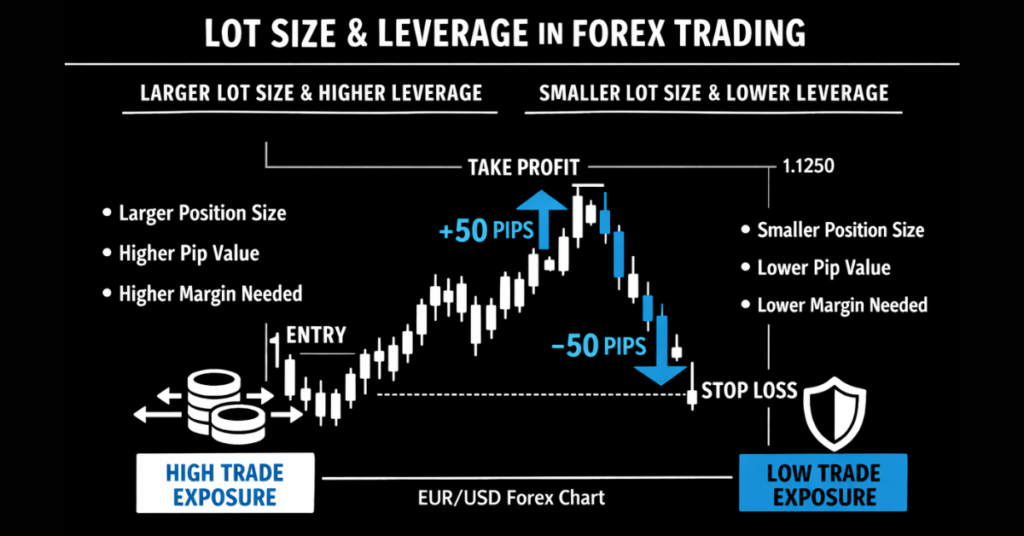
3) Forex lot sizes (How big your trade is)
A lot is the standardized unit of position size in forex.
Here are the typical forex lot sizes:
- Standard lot = 1.00 lot = 100,000 units of the base currency
- Mini lot = 0.10 lot = 10,000 units
- Micro lot = 0.01 lot = 1,000 units
- (Some brokers also offer nano lots like 0.001)
Base currency vs quote currency (why “units” matters)
In EUR/USD, the base currency is EUR and the quote currency is USD.
If you buy 1 standard lot of EUR/USD, you’re trading 100,000 EUR (not 100,000 dollars).
This is why lot size is the bridge between “a move of 10 pips” and “I made/lost $X.”
4) Putting pips + lots together (so tutorials make sense)
When a strategy says:
- “Aim for 30 pips, risk 15 pips, trade 0.20 lots”
You should immediately be able to interpret that as:
- Your stop-loss distance: 15 pips
- Your potential reward: 30 pips
- Your money risked depends on pip value at 0.20 lots
On EUR/USD, 0.20 lots is roughly $2/pip, so:
- Risk: 15 pips × 2/pip= 2/pip = ~2/pip= 30
- Reward: 30 pips × 2/pip= 2/pip = ~2/pip= 60
Now you’re not just copying a strategy—you’re reading it.
5) Forex leverage explained (Exposure vs deposit)
Leverage lets you control a larger position than your cash balance alone would allow.
If your broker offers 1:30 leverage, it means:
- For every 1∗∗youputupasmargin,youcancontrol∗∗1** you put up as margin, you can control **1∗∗youputupasmargin,youcancontrol∗∗30 of currency exposure.
If your broker offers 1:100 leverage:
- 1margincontrols100 exposure.
Key point that beginners miss
Leverage doesn’t force you to take huge risk.
It simply makes it possible to open larger positions.
Risk comes from position size (lots) and stop distance (pips)—not from leverage by itself.
6) Margin and margin requirement (the “deposit” for a trade)
When you open a leveraged trade, your broker locks some of your account as margin.
Margin requirement is often expressed as a percentage:
- 1:100 leverage ≈ 1% margin requirement
- 1:30 leverage ≈ 3.33% margin requirement
Simple margin example
If you open a position with $10,000 of notional value:
- At 1:100, margin ≈ $100
- At 1:30, margin ≈ $333
Your trade can still gain or lose based on the full $10,000 exposure—margin is just the collateral.
7) Free margin, margin level, and margin call (what blows accounts up)
These are the terms people only learn after a painful experience—so it’s worth getting them early.
- Equity = your balance plus/minus current floating P/L
- Used margin = margin currently locked for open positions
- Free margin = equity − used margin
- Margin level (often shown as a %) = (equity / used margin) × 100
If losses reduce your equity enough, your broker may:
- issue a margin call (warning)
- trigger a stop out (automatically close trades)
This is why “high leverage + oversized lots” is dangerous: it consumes margin quickly and leaves little room for normal price fluctuation.
8) A practical “translator” for strategy instructions
Here’s how I recommend mentally decoding any forex tutorial:
Step 1: Identify the stop-loss in pips
If you can’t find it, that’s a red flag. No stop = no defined risk.
Step 2: Convert pips to dollars using lot size
Use the rough EUR/USD pip values as training wheels:
- 1.00 lot ≈ $10/pip
- 0.10 lot ≈ $1/pip
- 0.01 lot ≈ $0.10/pip
Step 3: Check margin impact (especially with multiple trades)
Make sure you’re not using so much margin that a routine drawdown forces a stop-out.
Step 4: Decide risk first, then choose lots
This is foundational literacy in action:
- You pick what you’re willing to lose (e.g., $20)
- You know your stop distance (e.g., 10 pips)
- Then you calculate position size:
20/10pips=20 / 10 pips = 20/10pips=2 per pip → ~0.20 lots on EUR/USD
That’s how professionals think: risk → stop → size, not “How many lots can I open?”
Quick glossary (the terms you’ll see everywhere)
- Pip: standard unit of price movement
- Pipette: 1/10 of a pip (fractional pip)
- Lot: standardized position size (standard/mini/micro)
- Leverage: increases exposure relative to deposit
- Margin: collateral locked to hold a leveraged trade
- Spread: difference between bid and ask (your entry cost)
- Stop-loss (SL): exit level to cap loss
- Take-profit (TP): exit level to lock profit
The foundation you actually need before placing trades
If you only take one thing from this post, let it be this:
Pips tell you distance. Lots tell you dollars. Leverage tells you how easily you can overdo it.
When those three click, strategies stop feeling like “signals” and start feeling like math plus decision-making—which is exactly what trading becomes when you’re in control.
If you want, tell me:
- your account currency (USD/EUR/GBP etc.)
- the pair you’re watching (e.g., EUR/USD)
- and a typical stop size you’re considering (e.g., 12 pips)
…and I’ll show you a simple position-size table (0.01 to 1.00 lots) so you can instantly see pip value, $ risk, and margin impact.