
When I first opened a forex platform, the quote screen felt like an airport departures board: EUR/USD, GBP/JPY, USD/ZAR—letters everywhere, numbers moving, and a nagging sense that everyone else knew what they were looking at.
The good news: once you understand how currency pairs are quoted, what base and quote currencies mean, and why liquidity differs across pairs, the whole market becomes much less intimidating. This guide is written to do one thing well: help beginners decide which forex pairs to focus on first—without getting lost in jargon.
1) Currency pairs explained: why forex is always “this vs. that”
In forex, you’re never buying “a currency” in isolation. You’re buying one currency while simultaneously selling another. That’s why prices are quoted as pairs:
EUR/USD = 1.0850
This means 1 euro costs 1.0850 US dollars.
So when you trade EUR/USD, the real question is: Do you think the euro will strengthen or weaken against the dollar?
2) Base currency vs. quote currency (the one concept that unlocks everything)
Every pair is structured like this:
BASE/QUOTE
- Base currency = the first currency (left side)
- Quote currency = the second currency (right side)
- The price tells you: how much quote currency you need to buy 1 unit of base currency
Example:
- GBP/USD = 1.2700
- Base: GBP (British pound)
- Quote: USD (US dollar)
- Meaning: 1 pound costs $1.27
What does “buy” and “sell” actually mean?
- If you buy GBP/USD, you’re buying GBP and selling USD.
- If you sell GBP/USD, you’re selling GBP and buying USD.
This sounds trivial, but it prevents beginner mistakes like thinking you’re “buying the pair.” You’re taking a view on relative strength.
3) Why some pairs are more popular: liquidity, spreads, and “ease of trading”
Some currency pairs are traded heavily across banks, institutions, corporations, and retail traders. Others are thin, jumpy, and expensive to trade.
Three practical reasons certain pairs dominate:
A) Liquidity (how easy it is to get in and out)
High liquidity generally means the following:
- smoother movement
- fewer gaps
- more reliable pricing
- easier execution
B) Spreads (your “cost to enter”)
The spread is the difference between the bid and ask. More liquidity usually means tighter spreads (cheaper).
C) Consistent market attention
Pairs involving major economies get:
- more news coverage
- more analyst focus
- more predictable “active hours”
- deeper order flow
For beginners, these factors matter more than “finding the most exciting pair.”
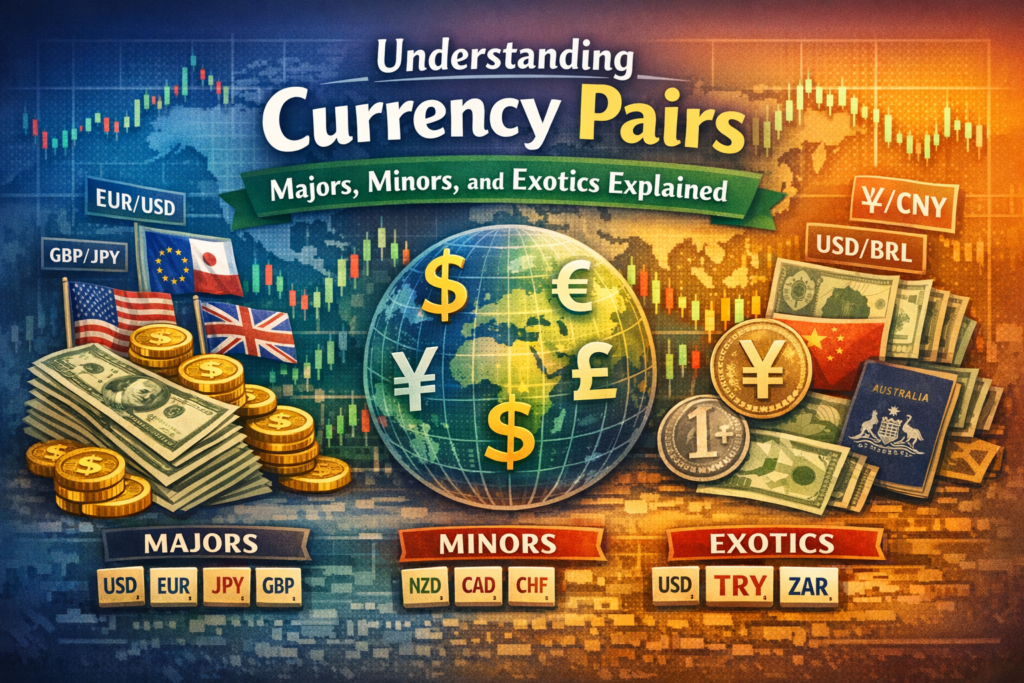
4) The three categories: majors, minors, and exotics
4.1 Major currency pairs (the beginner-friendly core)
Major currency pairs are the most traded pairs in the world and almost always include the US dollar (USD) plus another major economy’s currency.
Common majors:
- EUR/USD
- GBP/USD
- USD/JPY
- USD/CHF
- AUD/USD
- USD/CAD
- NZD/USD
Why majors are popular and liquid
- deep liquidity nearly 24/5
- typically tight spreads
- lots of educational material, analysis, and historical data
- generally less “random” price spikes than smaller markets
Beginner take: If your goal is to learn structure and risk control (not adrenaline), majors are usually the best classroom.
4.2 Minor currency pairs (a.k.a. “crosses”)
Minors (often called cross pairs) are major currencies without the USD.
Examples:
- EUR/GBP
- EUR/JPY
- GBP/JPY
- AUD/JPY
- CHF/JPY
How minors behave
- can trend strongly (especially JPY crosses)
- spreads can be wider than majors
- movement often reflects two separate stories at once (e.g., euro news and yen risk sentiment)
Beginner take: Minors are great once you understand majors—because they can move cleanly—but they demand more awareness of what’s driving both currencies.
4.3 Exotic currency pairs (higher risk, higher friction)
Exotics pair a major currency with a currency from a smaller or emerging economy.
Examples:
- USD/TRY (Turkish lira)
- USD/ZAR (South African rand)
- USD/MXN (Mexican peso)
- EUR/PLN (Polish zloty)
Why exotics can be tricky
- wider spreads (you pay more to enter/exit)
- sharper volatility and sudden spikes
- higher sensitivity to local politics, central bank actions, and liquidity shocks
- sometimes limited trading hours or less consistent pricing
Beginner take: Exotics can be educational later, but they’re rarely the best starting point because the “trading costs + volatility” combo punishes small mistakes.
5) How to choose forex pairs for beginners (a practical short list)
If you want a simple approach that I wish someone had handed me early on, it’s this:
Step 1: Start with 1–2 major currency pairs
Pick pairs with:
- tight spreads
- heavy liquidity
- tons of analysis available
Good “first pairs” for many beginners:
- EUR/USD (often the most liquid and widely covered)
- USD/JPY (reacts clearly to risk sentiment and rates)
- GBP/USD (moves more than EUR/USD; can be good once you want a bit more action)
If you like calmer movement, start with EUR/USD.
If you prefer more movement per session, GBP/USD often provides it (with a bit more volatility).
Step 2: Match the pair to your time zone
This is overlooked. You’ll learn faster if you trade when your pair is naturally active.
- EUR/USD, GBP/USD, EUR/GBP are most active during London and London–New York overlap
- USD/JPY, AUD/JPY, AUD/USD are more active during Asian session (and also moves on US data for USD pairs)
Your schedule matters more than people admit. I used to watch EUR/USD during hours it barely moved, get bored, and then force trades. That was a “me problem,” not a market problem.
Step 3: Avoid jumping between 10 pairs
Beginners often think more pairs = more opportunity. In practice:
- more pairs = more conflicting signals
- harder journaling and pattern recognition
- more news streams to track
A focused watchlist (2–4 pairs max) helps you learn the “personality” of a pair—how it trends, how it reacts to news, and what a normal day looks like.
6) “Personality” of pairs: what you’ll notice with screen time
Different pairs tend to behave differently because of who trades them and what drives them.
Here are a few beginner-friendly observations:
- EUR/USD: often smoother; reacts strongly to US data (CPI, jobs) and ECB/Fed expectations.
- GBP/USD: more volatile; can make larger intraday swings.
- USD/JPY: sensitive to US yields and risk sentiment; can trend well when rate expectations are clear.
- AUD/USD: often influenced by commodities and China-linked sentiment; can move during Asia hours more reliably than EUR/USD.
This “pair personality” becomes obvious after you journal 20–30 trades on the same instrument—another reason to start narrow.
7) A quick note on “majors vs. safe”: don’t confuse liquidity with low risk
Majors are easier to trade in terms of spreads and execution—but they can still move fast on major news. A liquid pair doesn’t guarantee gentle price action; it just means the market is deep and pricing is competitive.
So the beginner edge isn’t “majors won’t hurt you.” It’s that majors tend to be:
- cheaper to trade
- less prone to extreme gaps
- easier to study and understand
8) A simple starter plan (that builds confidence fast)
If your goal is to get from “confused” to “competent” efficiently:
- Choose 1 pair (EUR/USD is a solid default).
- Learn what drives it:
- central bank decisions
- inflation, employment, growth data
- risk-on/risk-off mood
- Watch it at the same time daily for two weeks.
- Keep a basic journal:
- time of day
- reason for trade
- result
- what you’d do differently
- Add a second pair only after you can describe your first pair’s behavior in plain language.
This is unglamorous, but it works.
Key takeaways (so you can act on this today)
- Currency pairs explained: forex quotes are always relative—one currency priced in another.
- Base currency is first, quote currency is second; price tells you how much quote you need for 1 base.
- Major currency pairs are most liquid and usually best for beginners (tight spreads, lots of data, easier execution).
- Minors can trend nicely but require understanding two non-USD drivers.
- Exotics often have wider spreads and sharper volatility—usually not ideal for learning.
- For forex pairs for beginners, start with 1–2 majors, match them to your active hours, and stay focused long enough to learn their “personality.”